Gemini 4 Argon Explained: Features, Pricing & API Guide
Google's Gemini 4 Argon explained through the periodic table: 1M-token output, thinking levels, agents, pricing, plus a cost calculator and API guide.
By Amal V S, Backend & AI Systems Architect · Thu Oct 15 2026
In chemistry, argon is the quiet one. Element 18, a noble gas, almost 1% of the air you're breathing. It doesn't react with much — which is exactly why welders pump it over hot metal: it shields the work from everything around it.
Google DeepMind picked that name for its first Gemini 4 model, and it fits better than most product names. Gemini 4 Argon is built to stay stable through very long, very hard tasks, to resist being hijacked by malicious instructions, and to write — not just read — up to a million tokens. Let's take it apart like an element: one property at a time.
Key takeaways
Announced 30 September 2026 as Google's new frontier model; broadly available to developers and Gemini app subscribers since 13 October.
Model ID
gemini-4-argon: text, image, video, audio and PDF in; text out; a 1,048,576-token window shared by input and output.Long decode: output can go up to ~1M tokens (from a 64K default) — for migrations, research and long reports.
Reasoning depth is controlled with
thinking_level— LOW, MEDIUM (default) or HIGH.temperatureis ignored.Introductory price: $2 / $10 per million input / output tokens, rising to $4 / $20 after the introductory period.
What is Gemini 4 Argon?
Argon is Google's flagship reasoning model, introduced by Google DeepMind on 30 September 2026 (Google announcement). Google positions it for three kinds of work: real-world software engineering, enterprise knowledge work such as legal and finance, and cyber defense.
Its rollout was staged:
30 Sept — trusted cyber defenders first, through Google's Fairwind Program.
13 Oct — paid Gemini API tier in Google AI Studio and Android Studio, Google's Antigravity agent platform (for AI Ultra subscribers), and the Gemini app for Google AI Pro and Ultra subscribers (Google developers, 9to5Google).
The periodic table of Argon
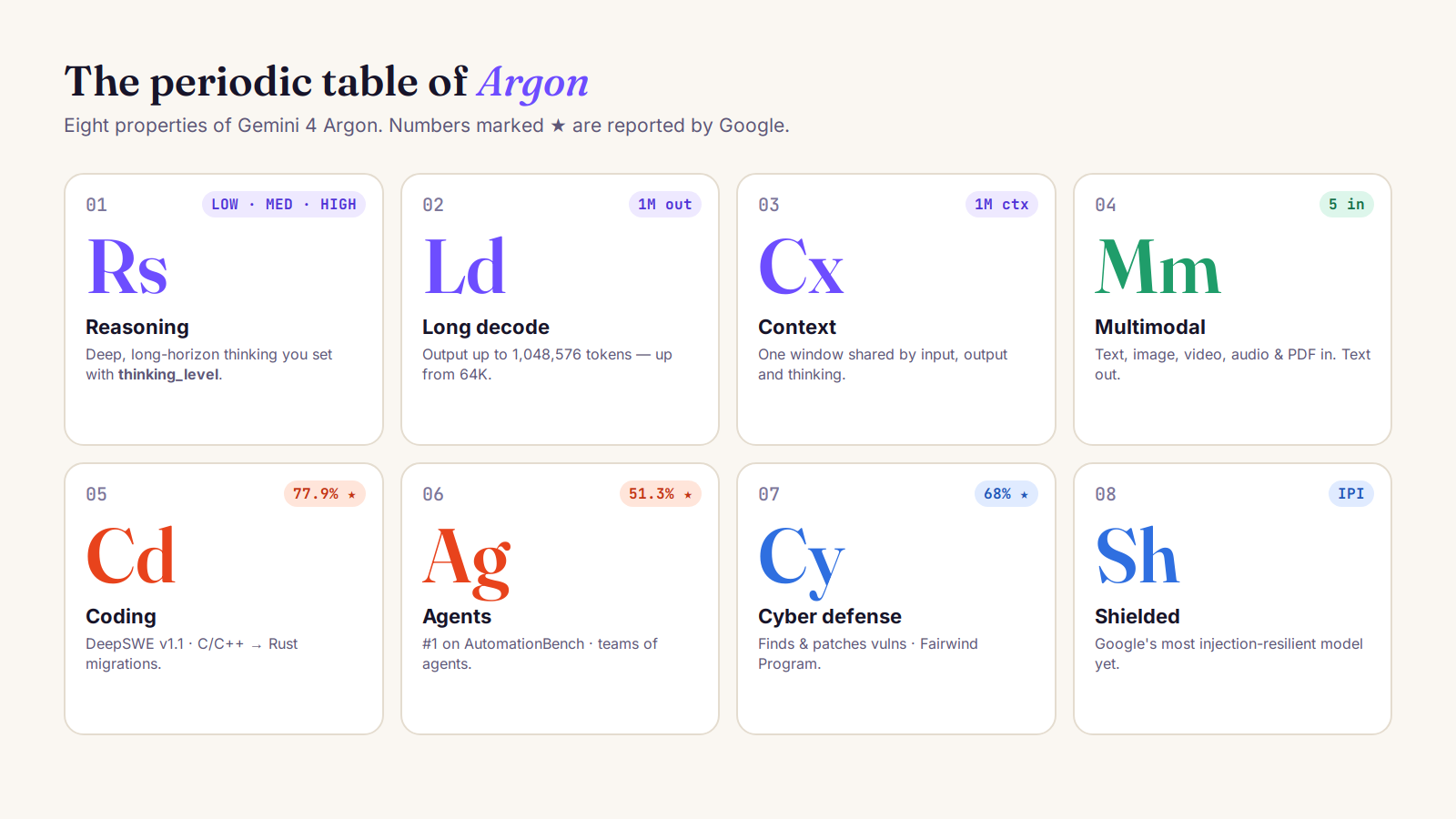
Rs — Reasoning you can dial
Argon is tuned for long-horizon reasoning: staying coherent across many steps instead of answering in one shot. You control how hard it thinks with thinking_level: LOW, MEDIUM (the default) or HIGH. The older thinking_budget and MINIMAL settings now return an HTTP 400 (developer guide).
Ld — Long decode: a model that can write a book
Most models can read huge inputs but stop writing after a few tens of thousands of tokens. Argon raises the output ceiling to 1M tokens, up from 64K. That's what makes jobs like migrating an entire codebase or drafting a long technical report possible in one pass.
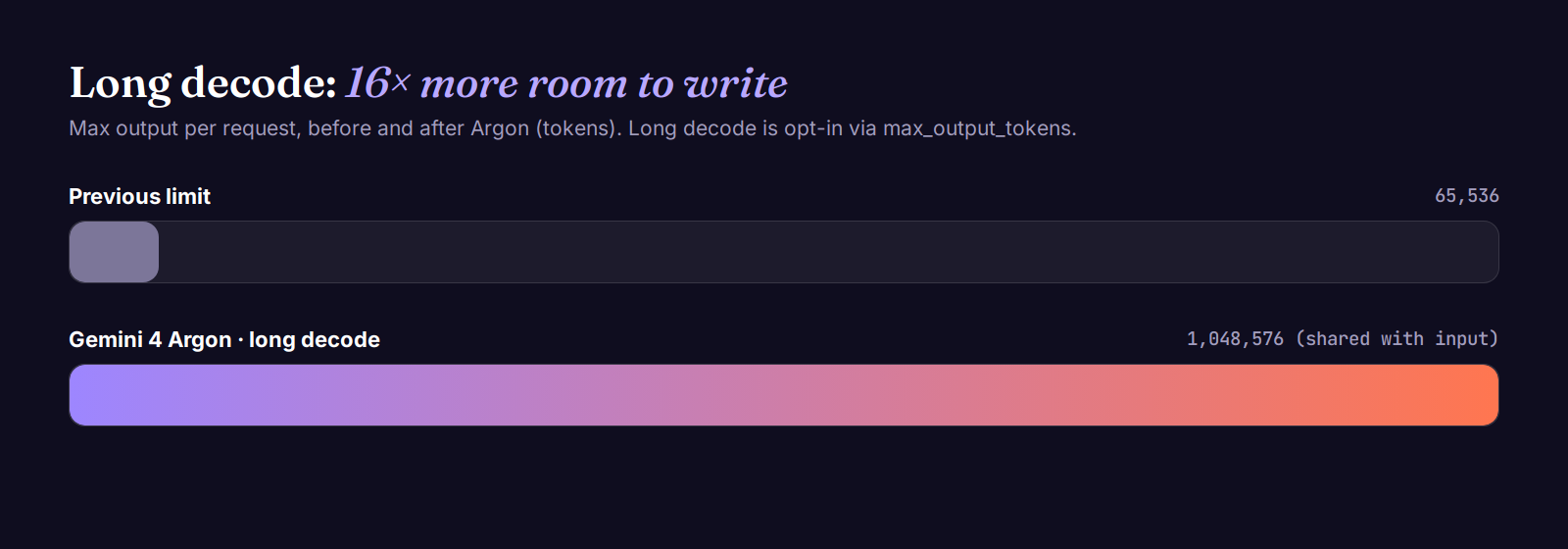
It's opt-in: set max_output_tokens above the default (65,536 when streaming). The Python SDK (google-genai 2.30.1+) stitches the pieces together automatically. Google's own advice is to use it selectively — great for hard maths, research and complex coding; wasteful for chat, classification or quick tool calls.
Cx — One shared context window
The 1,048,576-token window is unified: your prompt, the model's thinking, tool calls and the answer all come out of the same budget. A 600K-token prompt leaves at most ~450K for everything else. The calculator below makes that trade-off visible.
Mm — Multimodal in, text out
Argon accepts text, images, video, audio and PDFs, and responds in text (model spec). Google highlights professional chart analysis, pulling details out of long videos and working across stacks of documents — and reports a state-of-the-art 91.7% on LVBench for long-video understanding.
Cd — Coding at codebase scale
This is where Google tells its most concrete stories. According to the announcement, Argon is used internally for:
C/C++ → Rust migrations ranging from libraries like re2 and libgav1 up to 800K+ lines of the Fuchsia Zircon kernel.
libgav1: replacing 32K lines of SIMD code with a Rust decoder Google says runs 2.7× faster than the existing Rust port, with identical output.
DeepSWE v1.1: 77.9%, which Google reports as a new state of the art.
Ag — Agents that work in teams
Google describes teams of Argon agents autonomously finding and applying memory optimisations across its infrastructure — an effort it expects to free over 300 TiB of memory. On Zapier's AutomationBench it ranks #1 at 51.3%, and it supports function calling, code execution, search and maps grounding, file search and computer use (preview).
Cy — Cyber defense
Argon can find, validate and patch software vulnerabilities on its own. A cyber-permissive variant without the usual guardrails goes only to vetted defenders through the Fairwind Program. Google cites Wiz finding a critical healthcare-software vulnerability with it that earlier frontier models missed, and a tie for first on CWE-bench v1 at 68%.
Sh — Shielded, like the gas
The welding gas protects hot metal from the air. The model is built to protect your agent from the instructions hidden in what it reads.
Google calls Argon its most resilient model yet against indirect prompt injection — malicious instructions buried in web pages, emails or documents that an agent reads. It credits automated red teaming and adversarial training, plus monitors that watch the model's reasoning and actions and can halt execution. Google also urges the industry to keep model reasoning transparent so problems can be spotted.
What does it cost? Try the calculator
Introductory: $2 per 1M input tokens, $10 per 1M output tokens.
After the introductory period: $4 input, $20 output.
Cached input: 95% off. Only implicit caching is supported — put your static content (6,144+ tokens) first so repeated prefixes are reused.
Paid tier only on the Gemini API; search grounding is billed per query.
Notice how output dominates the bill: thinking tokens count as output, so a HIGH thinking level on a big job costs real money. Pick the level per task.
Using Gemini 4 Argon from code
Upgrade the Google Gen AI SDK, then call the model with a thinking level (developer guide):
pip install --upgrade "google-genai>=2.30.1"from google import genai
from google.genai import types
client = genai.Client() # reads GEMINI_API_KEY from the environment
response = client.models.generate_content(
model="gemini-4-argon",
contents="Find the race condition in this Go file and propose a fix: ...",
config=types.GenerateContentConfig(
thinking_config=types.ThinkingConfig(thinking_level="HIGH"),
),
)
print(response.text)For a very long answer, raise the output ceiling. The SDK continues the generation for you until it's done:
response = client.models.generate_content(
    model="gemini-4-argon",
    contents=migration_prompt,                 # e.g. a module plus its tests
    config=types.GenerateContentConfig(
        max_output_tokens=256_000,             # long decode: above the default limit
        thinking_config=types.ThinkingConfig(thinking_level="MEDIUM"),
    ),
)
Migrating from Gemini 3.x: the gotchas
Swap the model ID to
gemini-4-argon.Replace
thinking_budgetandMINIMALwiththinking_level— both now return HTTP 400.temperature,top_pandtop_kare ignored; use thinking levels andresponse_schemainstead.frequency_penalty,presence_penaltyandcandidate_countreturn HTTP 400.Explicit context caching is gone — rely on implicit caching with static content first.
No prefilled model turns: the chat history can't end with a model message.
Long decode works on the v1beta1 API (the SDK default), not on v1, and not through the OpenAI-compatibility layer.
When Argon is the right element — and when it isn't
Reach for it for codebase migrations, deep debugging, research, long reports and multi-step agents where one wrong step is expensive.
Skip it for chat, quick classification, latency-sensitive features and tight tool loops — a smaller, faster model will be cheaper and snappier.
Treat the scores as claims. The benchmark numbers here are reported by Google; test on your own tasks before you switch.
FAQ
What is Gemini 4 Argon?
Google DeepMind's first Gemini 4 model and current flagship reasoning model, announced on 30 September 2026, aimed at software engineering, enterprise knowledge work and cyber defense.
How big is Gemini 4 Argon's context window?
1,048,576 tokens, shared between input and output. Output defaults to 65,536 tokens and can go up to roughly 1M with long decode.
How much does Gemini 4 Argon cost?
$2 per million input tokens and $10 per million output tokens at introductory pricing, then $4 and $20. Cached input is 95% off.
Can I set the temperature on Gemini 4 Argon?
No — temperature, top_p and top_k are ignored. Control behaviour with thinking_level and structured outputs.
Sources: Google: Gemini 4 Argon announcement · Google: Build with Gemini 4 Argon · Gemini API model page · Developer guide · 9to5Google: Gemini app rollout. Performance figures are as reported by Google.