LLM vs NCM: Next-Concept Modeling Explained (2026)
LLM vs NCM explained: how Stanford's Next-Concept Modeling writes text coarse-to-fine in ~12 parallel steps, 10–31× faster than diffusion LMs.
By Amal V S, Backend & AI Systems Architect · Fri Oct 30 2026
Every large language model you use today, from ChatGPT to Claude to Gemini, writes the same way: one token at a time, left to right. A new research model from Stanford's Hazy Research lab, called Next-Concept Modeling (NCM), writes differently. It sketches the rough shape of the whole answer first, then fills in detail, level by level, with every part of a level written at the same time.
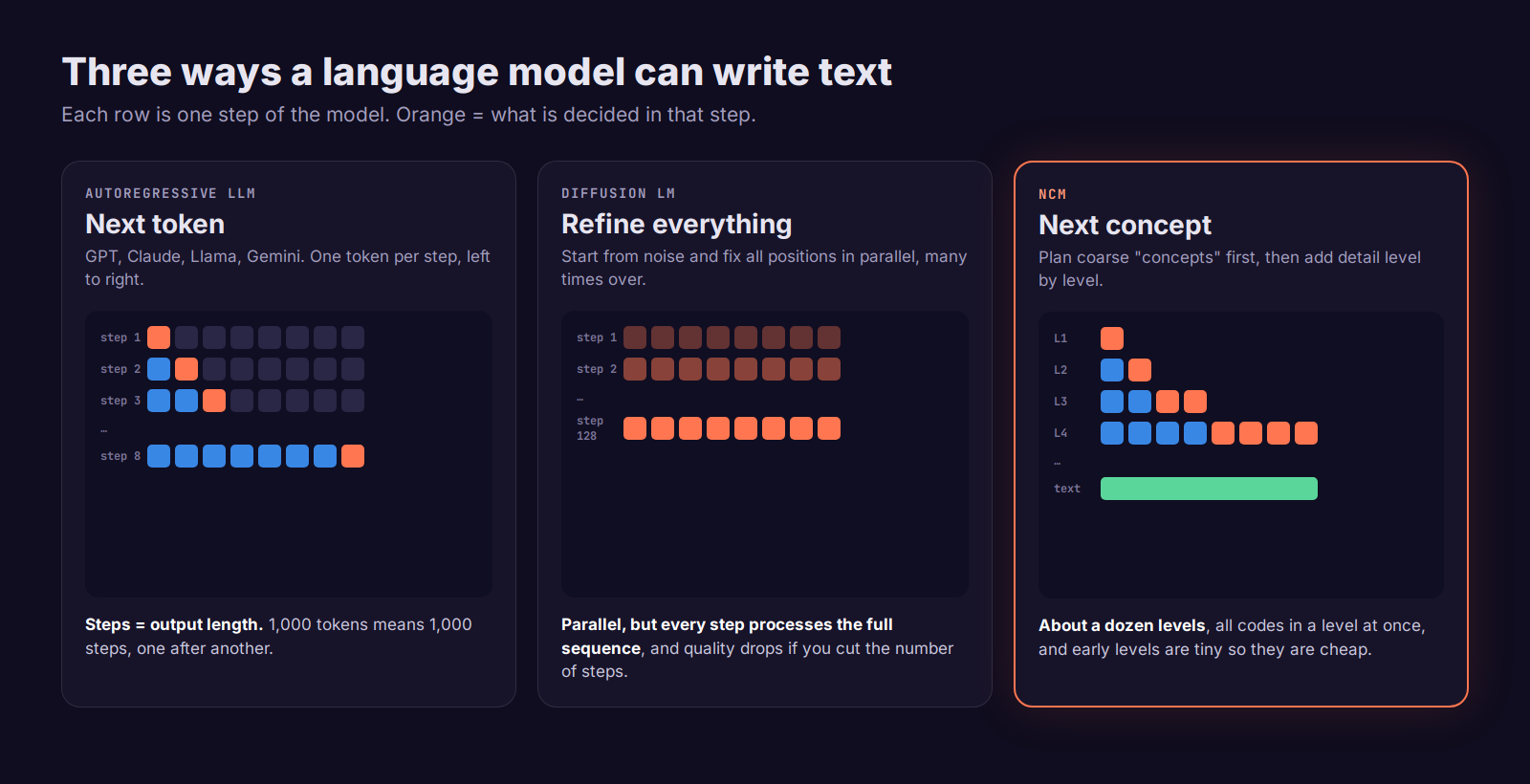
LLM vs NCM in one sentence: an LLM predicts the next token and needs one step per token; NCM predicts the next level of concepts, from coarse to fine, and finishes in about a dozen parallel steps no matter how long the text is.
In the paper, that design made text generation 10× to 31× faster than comparable diffusion language models. This guide explains how NCM works in plain words, how it compares with LLMs, what the results really show, and whether it matters to you yet.
How LLMs generate text: next-token prediction
A large language model is autoregressive. Given some text, it predicts the next token (a word or piece of a word), adds it to the text, and repeats. Each new token depends on every token before it, so the steps cannot run in parallel.
Strength: very high quality, and it scales. Every frontier model works this way.
Weakness: the number of sequential steps equals the length of the output. A 1,000-token answer means 1,000 forward passes, one after another.
No going back: once a token is written, it stays. The model cannot revise the start of a sentence after seeing how it ends.
Researchers have tried to break that bottleneck for years. The best-known alternative is the diffusion language model: start from a noisy or masked sequence and refine every position in parallel, over many rounds. It is parallel, but each round still processes the whole sequence, and quality drops when you cut the number of rounds.
What is Next-Concept Modeling (NCM)?
Next-Concept Modeling is a text generation method introduced in October 2026 by Hermann Kumbong, Ishan S. Khare and colleagues at Stanford's Hazy Research lab, advised by Simran Arora, Azalia Mirhoseini and Christopher Ré (arXiv:2610.14162). Instead of predicting tokens, NCM predicts a hierarchy of discrete codes, going from coarse to fine.
The idea comes from image generation. Models like VAR create an image by first generating a tiny low-resolution version and then adding detail at larger and larger scales. Text has no natural "low resolution", so NCM learns one.
Stage 1: a tokenizer that turns text into levels
First, a multiscale residual VQ tokenizer (a kind of VQ-VAE) learns to compress a piece of text into several levels of discrete codes. The first level has only a few codes and captures the broad gist. Each next level adds more codes that capture what the earlier levels missed. A decoder can turn the finished stack of levels back into text. This tokenizer is trained once and then frozen.
Stage 2: a transformer that predicts the next level
Then a transformer learns to predict each level from the levels before it. At generation time it produces level 1, then level 2, then level 3, and so on. Inside each level, all codes are predicted at once. When the last level is done, the decoder writes out the final text.
So NCM is sequential across levels but parallel within each level. That is the whole trick, and it is why the step count stays small.
What does "concept" mean here?
In NCM, a "concept" is simply the information stored in the coarse levels: the overall content and structure before the exact words are chosen. It is a useful name, not a claim that the model reasons in human concepts.
A real example: watching a translation sharpen
The authors show NCM translating a German sentence into English, decoding the text after each level:
German input: Es besteht allerdings die Sorge, dass kleine und mittlere Unternehmen angreifbar gegenüber Hacking und Überwachung bleiben.
After the first level, the output is barely readable. With each level it gets closer to the meaning. After level 11 of 11, NCM produced: "However, there is concern that small and medium-sized enterprises will remain vulnerable to hacking and surveillance." That scores 77.8 BLEU against the human reference, which says "companies" where NCM said "enterprises".
Why NCM is faster
NCM saves time in two ways at once:
Fewer sequential steps. On the LM1B benchmark, the DUO diffusion baseline uses 128 generator calls. NCM uses 12.
Cheaper steps. A diffusion model processes the full sequence on every step. NCM's early levels contain only a handful of codes, so those steps cost very little.
There is a bonus. Because sampling is so fast, the authors spend the saved time generating several candidates and picking the best one (minimum Bayes risk decoding), which improved translation and summarization scores further. Coarse-to-fine generation also seems to help with global constraints: on hard Sudoku puzzles, where every cell depends on the whole board, NCM solved 86.1% of boards.
LLM vs NCM: side-by-side comparison
Important: what the speedups are compared against
This is the detail many headlines skip. NCM's 10–31× speedups are measured against diffusion language models of similar size, on a single NVIDIA H100, mostly with generators of around 100 million parameters. They are not a comparison with GPT, Claude or Gemini. Frontier LLMs have hundreds of billions of parameters and years of serving optimizations (KV caching, speculative decoding, batching). Nobody has yet shown NCM beating a frontier LLM on general tasks.
NCM vs Meta's Large Concept Models (LCM)
The names are similar, so they are easy to mix up. Meta's Large Concept Models (December 2024) predict the next sentence as an embedding in the SONAR space, one sentence after another. That is still autoregressive, just at the sentence level. NCM is different: it predicts learned levels of discrete codes from coarse to fine, in parallel within each level.
Limitations of NCM today
Small scale: most experiments use ~100M-parameter generators. Scaling runs at 97M, 317M and 725M are described as preliminary.
Two separate stages: the tokenizer is trained first and frozen, so the generator cannot improve the representation it works with.
Fixed depth: every output goes through every level, even a very short one.
Artifacts: the authors note occasional glitches at the transitions between coarse levels.
Task-specific checkpoints: released models cover XSum, WMT14 De-En, Sudoku, LM1B, TinyStories and OpenWebText. There is no general chat model and no hosted API.
Not independently reproduced yet: all numbers above are the authors' own.
The authors list further scaling, training the tokenizer and generator together, and adaptive computation (fewer levels for easy outputs) as next steps.
How to try NCM yourself
The code is MIT-licensed on GitHub and the checkpoints are on Hugging Face. You need Python 3.10+ and a CUDA GPU.
git clone https://github.com/HazyResearch/ncm.git
cd ncm
pip install -r requirements.txt

# download checkpoints and data from hazyresearch/ncm-checkpoints and hazyresearch/ncm-datasets (hf download)
# then run an evaluation, e.g. summarization:
python evaluate.py --config config/eval/xsum.yaml --checkpoint-dir artifacts/xsum --data-dir data/xsum
The repository is built for reproducing the paper's evaluations rather than for chatting with a model, so expect research code.
Will NCM replace LLMs?
Not today, and maybe not in this form. But it is worth watching for three reasons:
Speed is the next battleground. Agents make dozens of model calls per task, so cutting sequential steps matters more every year.
It can revise globally. Coarse-to-fine generation can fix the whole output at each level, which helps on tasks with global constraints, where left-to-right writing struggles.
It is efficient to train: about 4–5× fewer training tokens in the paper's setups.
If you build AI products, the practical move is the same as always: keep your model choice flexible, measure latency, cost and quality on your workload, and test new architectures like NCM when they reach a scale and availability that fits your use case.
FAQ
What is NCM in AI?
NCM stands for Next-Concept Modeling, a text generation method from Stanford's Hazy Research lab. It generates text coarse-to-fine as a hierarchy of learned discrete codes, predicting all codes in a level in parallel.
What is the difference between an LLM and NCM?
An LLM predicts one token at a time, so it needs one sequential step per token. NCM predicts whole levels of codes from coarse to fine, so it needs only about a dozen sequential steps.
Is NCM faster than LLMs?
The paper reports 10–31× faster generation than diffusion language models of similar size. It does not compare against frontier LLMs like GPT or Claude, so a general "faster than LLMs" claim is not proven.
Who created Next-Concept Modeling?
Hermann Kumbong, Ishan S. Khare and colleagues at Stanford's Hazy Research lab, advised by Simran Arora, Azalia Mirhoseini and Christopher Ré. The paper is arXiv:2610.14162 (October 2026).
Is NCM the same as Meta's Large Concept Model?
No. Meta's LCM predicts the next sentence embedding one sentence at a time. NCM predicts coarse-to-fine levels of discrete codes in parallel within each level.
Can I use NCM today?
Yes, for research. The code is MIT-licensed on GitHub and task-specific checkpoints are on Hugging Face, but there is no general-purpose model or hosted API yet.
Sources: Next-Concept Modeling: Fast, Parallel Coarse-to-Fine Text Generation (arXiv:2610.14162) · Hazy Research blog post · HazyResearch/ncm on GitHub · Eden AI: NCM vs LLM. All benchmark figures are as reported by the authors.