NGINX2Root Explained: 5 Critical nginx Flaws and Fixes
NGINX2Root: five critical nginx vulnerabilities, led by CVE-2026-123007. Check if you are exposed, see fixed versions, and patch or mitigate today.
By Amal V S, Backend & AI Systems Architect · Tue Nov 24 2026
What is NGINX2Root? NGINX2Root is the name for five nginx vulnerabilities disclosed on November 18, 2026. If a matching feature is enabled, an unauthenticated attacker can crash an nginx worker and may be able to run code as that worker. The fix: upgrade to nginx 1.30.8 (stable) or 1.31.10 (mainline), or your distribution's patched package, then fully restart nginx.
The most serious flaw sits in nginx's HTTP/2 code and has been there since version 1.9.5, released in 2015. If you run a typical HTTPS site, this is probably the one that matters to you. Here is what is affected, how to check in two minutes, and what to do if you cannot patch today.
NGINX2Root at a glance
| Question | Answer (as of November 24, 2026) |
|---|---|
| CVEs | CVE-2026-123007, 123633, 121810, 123634 and 113425 |
| Fixed in nginx Open Source | 1.30.7 and 1.31.9 or later. Go to 1.30.8 or 1.31.10, released November 23, which fix one more flaw |
| Severity | F5 scores CVE-2026-123007 at 9.2 (CVSS 4.0) and 8.1 (CVSS 3.1). nginx.org rates two of the five major and three medium |
| Login needed by the attacker? | No |
| Gives root on its own? | No. That needs a separate Linux kernel flaw |
| Public exploit code? | Yes, a proof of concept for CVE-2026-123007 |
| Attacks seen in the wild? | None in the reports I reviewed, and no nginx entry in CISA's KEV catalog dated November 23 |
Check if you are exposed
Being on an old version is only half the question. Each flaw also needs a particular feature to be in use.
These commands give you the answers:
nginx -v                                   # version on disk
sudo nginx -T 2>/dev/null | grep -nE 'http2|quic|http3|resolver|mirror|ssi|mail'

# Is HTTP/2 reachable from outside? Look for: ALPN protocol: h2
openssl s_client -connect example.com:443 -servername example.com -alpn h2 </dev/null 2>/dev/null | grep ALPN
Check every place nginx runs: servers, container images, Kubernetes ingress controllers and appliances that bundle it.
The five nginx vulnerabilities
Version ranges are from the official nginx security advisories. Some news articles list different starting versions.
| CVE | What is wrong, and when it applies | Vulnerable versions |
|---|---|---|
| CVE-2026-123007 | Memory corruption in HTTP/2 flow control. Needs HTTP/2 enabled | 1.9.5 to 1.31.8 |
| CVE-2026-123633 | Use-after-free in HTTP/2. Needs HTTP/2, a proxied backend, and a worker running low on connections | 1.19.7 to 1.31.8 |
| CVE-2026-121810 | Use-after-free in HTTP/3, when worker connections run out | 1.25.0 to 1.31.8 |
| CVE-2026-123634 | Use-after-free in the resolver, when subrequests look up the same name at once | 0.6.18 to 1.31.8 |
| CVE-2026-113425 | Use-after-free in the mail proxy | 0.5.33 to 1.31.8 |
Releases 1.30.7 and later in the 1.30 branch are fixed, even though their number is below 1.31.8. A use-after-free means the program keeps using memory it has already given back, which an attacker may be able to control.
Does NGINX2Root really give attackers root?
Not by itself, and this is the most misunderstood part.
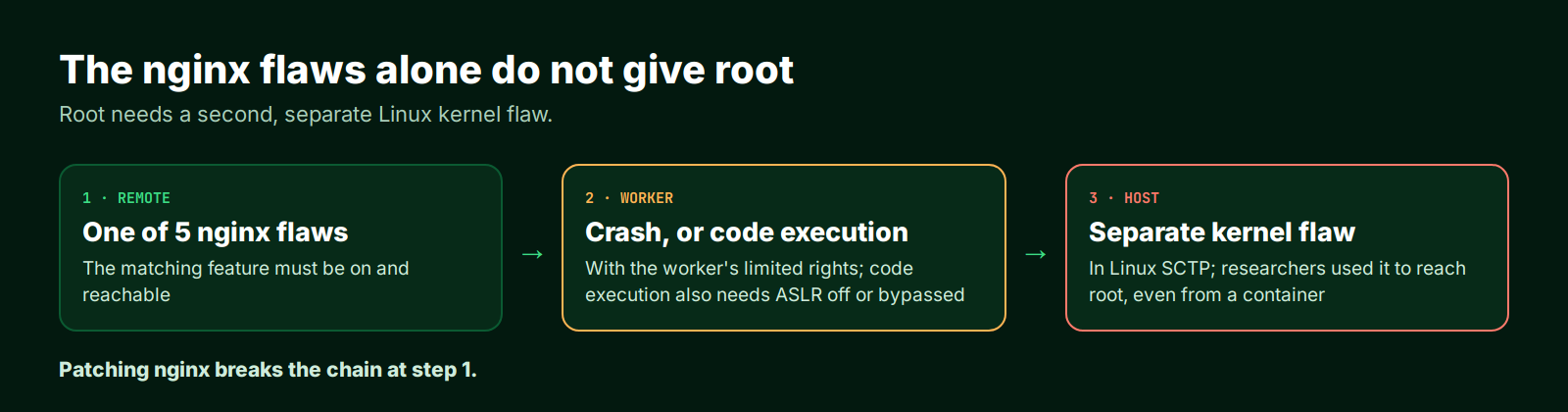
The nginx flaws can crash a worker. Code execution, if achieved, has the worker's limited rights.
F5 says code execution needs ASLR (a memory-randomisation protection) to be off or bypassed. Researchers report bypassing it in some setups, so treat ASLR as a speed bump and not a fix.
Root came from chaining a separate Linux kernel flaw in SCTP. Xint says its chain reached host root from a Docker container. Reports around November 19 described that kernel flaw as unpatched, so watch your distribution's kernel updates.
How to fix NGINX2Root
1. Upgrade nginx
| Platform | Status on November 24, 2026 |
|---|---|
| nginx.org packages | 1.30.8 (stable) or 1.31.10 (mainline) |
Docker nginx:alpine, nginx:stable-alpine | Now 1.31.10 and 1.30.8 (I pulled both to check) |
| Debian | Bookworm 1.22.1-9+deb12u11 and Trixie 1.26.3-3+deb13u11 (security repository) |
| Ubuntu | Tracker lists fixes for 20.04 to 26.10. Older releases may need Ubuntu Pro |
| Red Hat | Fixed packages for RHEL 8, 9 and 10, dated November 20 |
| NGINX Plus | 37.0.8.1 and 37.3.0.1, per Qualys; check F5 for older releases |
| Community ingress-nginx | Archived in March 2026, with no further fixes. Plan a migration |
Distribution packages keep their old version number. A patched Debian server still reports 1.22.1, so compare the full package version, not just nginx -v.
# Debian / Ubuntu
sudo apt update && sudo apt install --only-upgrade nginx

# RHEL family
sudo dnf upgrade nginx

# Docker: pull, rebuild your own image, recreate the container
docker pull nginx:stable-alpine
docker compose build --pull && docker compose up -d
On Debian and Ubuntu, also upgrade the related nginx-* packages you have installed, such as nginx-core.
2. Restart, don't reload
A reload starts new workers from the old program already in memory. Restart fully:
sudo nginx -t && sudo systemctl restart nginx

# Old program still running? This prints a line ending in (deleted)
sudo ls -l /proc/$(pgrep -o -x nginx)/exe
Can't patch today? Temporary mitigations
Each one covers only its own flaw. Disabling HTTP/2 stops two of the five.
| Flaw | Temporary step | Side effect |
|---|---|---|
| 123007 and 123633 | nginx 1.25.1+: http2 off; in each server, and remove http2 from listen. Older: remove it from listen | Breaks gRPC and HTTP/2-only clients |
| 121810 | Remove listen … quic lines, set http3 off;, and consider blocking UDP 443 | No HTTP/3 |
| 123634 | Use a fixed upstream in proxy_pass; mirror off; where not needed. Check SSI and other subrequests too | Config change needed |
| 113425 | Keep mail listeners on loopback or trusted IPs only | No public mail proxy |
| Kernel step | If you don't use SCTP, add install sctp /bin/false to a file in /etc/modprobe.d/ | Does not unload SCTP if it is already loaded |
Restart nginx after any of these changes, then test your site.
How to spot a possible attack
Equixly and Qualys reported no published indicators of compromise at disclosure. Useful signals:
Strongest: an nginx worker starting a shell or another program. Workers almost never should.
Repeated
signal 11or "worker process … exited" lines in the error log.Unusual outbound connections from the nginx user.
Long-lived TLS connections that keep receiving data but log few requests.
sudo grep -E 'signal 11|exited on signal' /var/log/nginx/error.log
ps -eo user,pid,ppid,args | grep '[n]ginx: worker'
coredumpctl list nginx
None of these proves an attack; crashes have ordinary causes too. If a worker did spawn a shell, isolate the machine and preserve evidence before rebuilding.
Beware of fake tools. Kudelski warns that third-party "nginx2root" exploits and scanners should be treated as untrusted.
How many servers are affected?
Censys estimated about 8.8 million services potentially exposed to CVE-2026-123007 as of November 19, based on version and HTTP/2 (BleepingComputer). "Potentially" matters: backported fixes hide behind old version numbers.
Timeline
| Date (2026) | Event |
|---|---|
| October 11 to 16 | Xint finds the flaws and reports them to F5 |
| October 21 | Wiz reports CVE-2026-123633 |
| November 18 | Disclosure; nginx 1.30.7 and 1.31.9 released |
| November 20 | Red Hat fixes dated |
| November 23 | nginx 1.30.8 and 1.31.10 released, fixing CVE-2026-132779 |
FAQ
Which nginx version fixes NGINX2Root?
1.30.7 and 1.31.9 fix all five flaws. Install 1.30.8 or 1.31.10 to get the November 23 fix as well.
Am I affected if HTTP/2 is off?
Not by CVE-2026-123007 or CVE-2026-123633. Check HTTP/3, resolver subrequests and the mail proxy for the other three, and upgrade anyway.
Is nginx inside Docker safe?
No. The container needs a patched image too, and running containers keep the old version until you recreate them.
Does a reverse proxy or CDN in front protect me?
It can shield the HTTP/2 and HTTP/3 flaws if it handles those connections itself and nobody can reach nginx directly. Confirm that, and still patch.
Is NGINX2Root being exploited?
I found no confirmed attacks as of November 24, 2026, but a public proof of concept exists, so do not wait.
Is a reload enough after updating?
No. Restart nginx fully, because a reload keeps the old program in memory.
Sources: nginx.org · Xint · Qualys · watchTowr · BleepingComputer · Equixly · Kudelski · CISA KEV. Last updated November 24, 2026. This is an independent article, not affiliated with F5 or NGINX.