What Is Jev AI? How It Works, Use Cases and Tools Explained
Jev is TypeSafe AI's model that makes decisions instead of writing text. A simple guide to how it works, real use cases, tools, cost and its limits.
By Amal V S, Backend & AI Systems Architect · Wed Nov 04 2026
What is Jev? Jev is an AI model from TypeSafe AI that makes decisions instead of writing text. You give it some information and a few questions with answers you define in advance. It returns a choice, a score or a true/false probability, in under half a second according to TypeSafe, along with how sure it is. Your software can use that answer directly.
Think of a chatbot as a colleague who answers everything with a long paragraph that you then have to read and interpret. Jev is the colleague who only fills in the form you hand them: tick one box, give a rating, answer yes or no, and mark how confident they are. Developers have started calling it "a very smart if-statement".
This guide explains Jev in plain language, so you do not need to be a developer for the first half. Then it shows how it works, what it is really used for, the tools around it, and when not to use it.
Note: this article is about Jev, the AI model. If you were looking for JEV, the Japanese encephalitis virus, this is not that.
Jev at a glance
| Question | Answer |
|---|---|
| What is it? | An AI model that returns typed decisions, not text |
| Who makes it? | TypeSafe AI, founded by Diogo Almeida |
| When was it released? | September 15, 2026 (Jev 1.14 followed on October 14) |
| Category | A "System One" model, named after Kahneman's fast, intuitive thinking |
| What it returns | Choice, Score or Noul (a yes/no probability), with probabilities |
| Reported speed | 70 to 500 milliseconds per request, according to TypeSafe |
| Price | $0.042 per million input tokens; output tokens are free |
| Can it write text or code? | No. It works alongside an LLM, not instead of one |
Why does Jev exist?
A lot of the AI work inside software is not writing. It is small judgments: Is this email spam? Which team should get this ticket? Is this AI answer safe to show? Today, many apps ask a large language model (LLM) those questions. That works, but it is like hiring a novelist to tick a checkbox:
It is slow. An LLM writes its answer one small piece at a time, even when the answer is one word.
It is costly at scale. Millions of small judgments add up.
It can reply in the wrong format. Your code expects "billing" and gets "I think this is probably a billing issue."
Jev is built only for this job. It gives up writing, and in return it answers quickly and always in the format you asked for.
| LLM (ChatGPT, Claude, Gemini) | Jev | |
|---|---|---|
| Output | Free-form text and code | Typed answers from options you define |
| How it answers | One token at a time | All questions in one parallel pass |
| Reported response time | 3 to 329 seconds | 70 to 500 milliseconds |
| Input price per million tokens | $0.20 to $10 | $0.042 |
| Output price | About 5× the input price | Free |
| Wrong-format answers | Possible | Not possible by design |
| Can the answer still be wrong? | Yes | Yes |
| Best at | Writing, coding, long reasoning | Classifying, routing, scoring, checking |
Speed and price comparisons are from TypeSafe's own tests and have not been independently verified. The company also says its pricing may be subsidized.
Why the name? According to the founder's launch thread, Jev is named after William Stanley Jevons, of the Jevons paradox: when something becomes cheaper and more efficient, people use more of it. The bet is that once decisions are cheap enough, software will make far more of them.
How does Jev work?
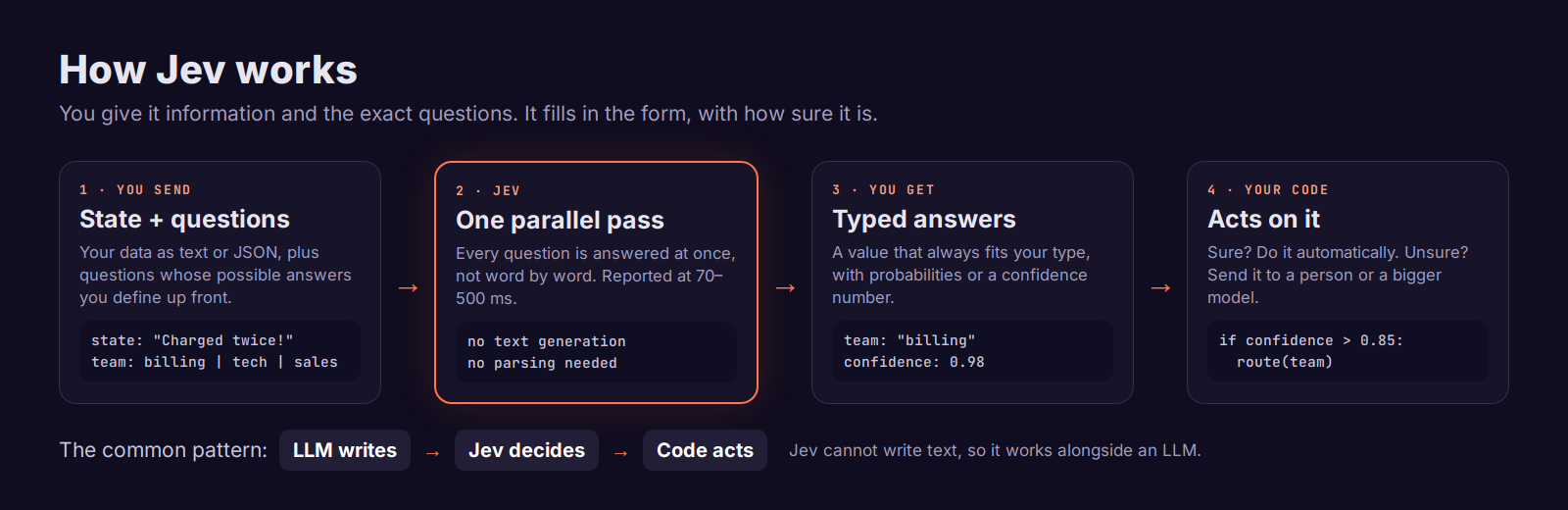
Every Jev request has just two parts: the state (the information to judge) and the questions (what you want to know about it).
The three types of question
| Type | What it does | Everyday example | Example answer |
|---|---|---|---|
| Choice | Picks one option from your list | Which team should handle this ticket? | technical |
| Score | Rates something on a scale you describe | How frustrated is this customer? (0 calm, 1 frustrated, 2 very angry) | 0.67 |
| Noul | Says how likely a statement is to be true | This message is urgent | 0.99 |
You can ask many questions in one request. They are all answered in parallel against the same information, and you are charged once for the input.
Jev 1.14 also adds an experimental box type and image input, which TypeSafe does not recommend for production yet.
Confidence: knowing when not to trust the answer
This is Jev's most useful feature. Choice and Score answers come with a confidence number from 0 to 1, and Noul is itself a probability. So your software does not have to blindly obey the model. It can act when Jev is sure, and ask a person when it is not.
What is Jev used for? Real use cases
| Use case | What Jev decides | Example |
|---|---|---|
| Customer support | Team, urgency, frustration, refund request | Send "I was charged twice" straight to billing and flag it as urgent |
| AI model routing | Which LLM should handle a request | Simple question goes to a cheap model; a difficult one goes to a frontier model |
| AI safety guardrails | Is this prompt, answer or tool call safe? | Check for jailbreaks or policy violations, or stop an agent running a risky shell command |
| Search | Which results are actually relevant? | Re-rank search results, or select context for a RAG system |
| Large datasets | Label every record | Sort a million reviews by topic and sentiment |
| Recruiting | Evidence for job-related criteria | Route applications, and send uncertain ones to a person |
| Sales leads | Customer fit and buying intent | Score inbound messages and prioritize follow-ups |
| Code quality | Does this follow our conventions? | Run team-specific checks in CI, beyond what a normal linter sees |
| Real-time apps and games | The next action, many times a second | TypeSafe's demo plays Doom at about 10 decisions per second |
TypeSafe keeps a longer list in its use case map. Use special care with decisions about people, such as hiring: keep a human in the loop and check for unfair results.
The most common pattern: LLM writes, Jev decides, code acts
Jev rarely works alone. A support tool, for example, might use Jev to route a ticket, an LLM to draft a reply, Jev again to check the draft follows policy, and plain code to send it. Browser Use's open-source agent does the same: Jev picks the next action on a web page, and a small LLM writes text only when something must be typed.
How much could it save?
As a worked example, TypeSafe's three-question ticket uses 428 input tokens. At $0.042 per million, that is about $0.000018 per ticket, or about $18 per million tickets.
Jev tools and integrations
Official tools from TypeSafe
| Tool | What it is for |
|---|---|
| Playground | Try Jev in your browser, with no code |
Python SDK (typesafe-sdk) | Call Jev from Python 3.10+ |
JavaScript/TypeScript SDK (@typesafe-ai/sdk) | Call Jev from Node.js, with typed answers |
| REST API | Call POST /v1/systemone on api.typesafe.ai from any language |
| skills (agent skill) | Teaches Claude Code, Codex and other coding agents how to use Jev |
Popular tools built with Jev
| Project | What it does | GitHub stars |
|---|---|---|
| jev-ultrafast | A fast web browsing agent where Jev picks each action | 24k |
| fast-jev-compaction | Claude Code plugin that scores and drops stale context | 7.8k |
| SemIf-OpenJev | Independent project doing "semantic ifs" with open models on your own GPU (not affiliated with TypeSafe) | 4.9k |
| jevgrep | Find code by describing what it does | 3.2k |
Star counts are as of November 4, 2026. For more, see the community list awesome-jev, which itself warns that being listed is not an endorsement, so check any project before you use it. Jev is also listed on Vercel AI Gateway.
How to try Jev
Without code
Open the Playground and log in. Paste some text, add a question such as "Does this message express urgency?", and read the answer.
With Python
Create an API key in the TypeSafe console, then install the SDK. This is TypeSafe's own quick start example:
python3 -m venv .venv
.venv/bin/pip install typesafe-sdk
export TYPESAFE_API_KEY="your-api-key"
from typesafe_sdk import Choice, Noul, Score, TypeSafeClient
ticket = "Our API integration started returning 500 errors on every request about 20 minutes ago, and we can't process any customer orders until this is fixed."
with TypeSafeClient(model="jev-latest") as client: # Reads TYPESAFE_API_KEY.
response = client.system_one(
state=ticket,
questions={
"department": Choice(
instructions="Which team should handle this",
criteria={
"billing": "Payment or subscription issues",
"technical": "Bugs or integration problems",
"sales": "Pricing or account questions",
},
),
"frustration": Score(
instructions="How frustrated the customer appears",
criteria=[
"Calm, just stating facts",
"Frustrated but civil",
"Very angry, strong language",
],
),
"is_urgent": Noul(
instructions="The message conveys urgency or time-sensitivity",
),
},
)
print(response.choices["department"].choice)
print(response.scores["frustration"].score)
print(response.nouls["is_urgent"].noul)TypeSafe's example output, which can change between releases:
technical
0.67
0.99
For production, pin an exact version such as jev-1.14.0 rather than jev-latest, so an update cannot change your results unexpectedly. I explain why in AI Technical Debt Explained.
With a coding agent
# Claude Code
claude plugin marketplace add typesafe-ai/skills
claude plugin install typesafe@typesafe-ai

# Other agents
npx skills add typesafe-ai/skills --skill typesafe-ai
When not to use Jev
Jev's type-safe answers can still be wrong. TypeSafe publishes a helpful list of known weaknesses:
| Weak spot | What goes wrong | Do this instead |
|---|---|---|
| Writing | It cannot write text, code or summaries | Use an LLM |
| Math and counting | It is not a calculator and does not count reliably | Do the math in code |
| Date comparison | It struggles to compare dates and times | Extract the dates, compare in code |
| Literal reading | It answers what you wrote, not what you meant | State exact conditions and boundary cases |
| Large, noisy input | Accuracy drops with irrelevant detail | Send only what the question needs |
| Hostile input | Injected or misleading text can move the answer | Write precise criteria and test edge cases |
| Vague, broad questions | "Rate this startup pitch" works poorly | Ask several narrow questions, then combine them in code |
Also keep a few practical points in mind:
Self-reported numbers. The speed, cost and accuracy figures come from TypeSafe, and it says so. Test on your own data.
Your data leaves your system. Jev is a hosted API, so check privacy and compliance first.
High-risk decisions need a person. Money, health, hiring and legal outcomes should not rest on a probability alone.
If normal code can do it, use normal code. A regular expression is free, instant and always gives the same result.
The takeaway
Jev does not replace ChatGPT or Claude. It handles the many small judgments that do not need a full LLM, and it does so quickly and in a format software can trust. The simplest way to remember it: LLMs write, Jev decides, code acts.
To see Jev's idea in action, look at any place in your app where you ask an LLM for one word, then parse its reply. That is a good first candidate. And if you are building with agents, see how DeepSeek Super-Agent approaches the same question of when software should act.
FAQ
What is Jev AI?
Jev is a System One AI model from TypeSafe AI. It takes text or JSON and questions with predefined answers, and returns typed decisions with probabilities instead of generated text.
Is Jev an LLM?
No. It is transformer-based and understands natural language like an LLM, but it does not generate text. It answers every question in a single parallel pass.
Can Jev replace ChatGPT?
No. Jev cannot chat, write or code. It complements an LLM by handling fast decisions such as classification, routing, scoring and checking.
How much does Jev cost?
TypeSafe lists $42 per billion input tokens, which is $0.042 per million, and output tokens are free.
How fast is Jev?
TypeSafe reports 70 to 500 milliseconds end to end. Independent results may differ.
What is a Noul in Jev?
A Noul is a question type that returns a probability from 0 to 1 that a statement is true, such as 0.99 for "this message is urgent".
Can Jev hallucinate?
It cannot return an answer outside the options you defined, so it cannot invent a format or a new category. But it can still choose the wrong option, so check the confidence and test it on your data.
What does System One mean?
It is TypeSafe's name for models built for fast, structured decisions. It comes from Daniel Kahneman's book Thinking, Fast and Slow, where System 1 is fast and intuitive thinking.
Sources: TypeSafe launch post · Jev 1.14 announcement · TypeSafe documentation · Jev models and pricing · Model jaggedness. Performance and pricing figures are as reported by TypeSafe. Last updated November 4, 2026.