Uncensored AI Models: Risks, Real Uses and How to Stay Safe
What uncensored AI models are, why people use them, how they can cause harm, their legitimate uses, and how to use one responsibly with your own guardrails.
By Amal V S, Backend & AI Systems Architect · Mon Nov 09 2026
What is an uncensored AI model? An uncensored model is a language model whose safety training has been removed or never added, so it answers almost any request instead of refusing. That makes it useful for some legitimate work, such as fiction, security research and safety testing, but it also removes the protection against scams, malware and dangerous advice. When you use one, all of the safety becomes your job.
Ask a mainstream chatbot to write a truly menacing villain for your novel and it may soften the scene or add a lecture. Ask an uncensored model and it simply writes it. Now ask both to write a convincing scam email that steals bank logins. One refuses. The other writes it, politely, in any language, as many times as you like.
That is the whole story of uncensored AI in two requests. This guide explains what these models are, why people want them, the real harms, the legitimate uses, and how to use one without becoming the weakest link.
Uncensored models at a glance
| Aligned model (ChatGPT, Claude, Gemini, most open models) | Uncensored model | |
|---|---|---|
| Refuses harmful requests | Yes | Rarely or never |
| Over-refuses harmless requests | Sometimes | Rarely |
| Adds safety caveats | Usually | Usually not |
| Who is responsible for safety | Shared between the provider and you | Entirely you |
| Where it usually runs | Provider's cloud | Your own hardware |
| Good for | Almost everything | A few specialist, supervised tasks |
What does "uncensored" actually mean?
A raw language model learns from huge amounts of internet text, good and bad. Companies then add safety training (often called alignment): they teach the model to be helpful, to follow instructions, and to decline clearly harmful requests. "Uncensored" models are versions where that refusal behaviour has been taken out.
You will see a few names for them:
Uncensored fine-tunes: a model retrained on data with the refusals removed.
"Abliterated" models: researchers found that refusal behaviour in many models is controlled by a single direction inside the model (Arditi et al., 2024). Removing that direction makes the model stop refusing, often with some loss of quality.
Base models: raw pretrained models that never had safety or instruction training. They are not designed to chat at all.
One important point: removing refusals does not add knowledge. An uncensored model does not know secret things. It is the same model, with its brakes removed, and often slightly worse at reasoning.
Why do people want uncensored models?
Most people who look for them are not villains. The usual reasons are reasonable:
Over-refusal. Aligned models sometimes refuse harmless things: dark fiction, history of violence, medical questions, or security education.
No lectures. Professionals get tired of disclaimers on every answer.
Privacy and control. They usually run locally, so nothing leaves your machine.
Research. Safety researchers need models that show what an unrestricted AI can do, in order to defend against it.
But the same freedom that helps a novelist also helps a scammer. Try it yourself:
How uncensored models can be harmful
1. They make abuse cheap and scalable
Phishing emails, fake reviews, harassment messages, scam scripts and disinformation used to take effort and good language skills. An uncensored model produces them fluently, in any language, at unlimited volume. It does not make a criminal smarter, but it makes bad work much faster and cheaper.
2. They lower the barrier for dangerous technical help
An uncensored model will attempt to write malware or explain dangerous procedures without hesitation. The output is often wrong or buggy, but it can still help someone who would otherwise have given up. That is exactly the gap safety training tries to close.
3. Confident answers with no caveats
Aligned models add warnings for medical, legal and financial questions for a reason: models make mistakes. Uncensored models give the same mistakes, stated bluntly, with no "check with a doctor". For a vulnerable person, the missing caveat can matter more than the answer.
4. Agents that obey anyone
If an AI agent can read web pages, emails or files, those can contain hidden instructions (prompt injection). A model trained never to refuse is more likely to follow them. An uncensored model with access to tools, files or payments is a serious security risk.
5. Lower quality
Removing refusals can damage other abilities. Many uncensored variants score worse on reasoning and instruction-following than the original model.
6. Risky downloads
Community model files come from unknown publishers. Some older model formats (Python "pickle" files) can run code on your computer when loaded. Prefer the safetensors format and well-known sources.
7. Legal and licensing trouble
Generating illegal content is illegal whatever model you use, and some content, such as sexual material involving minors, is illegal everywhere and absolutely off-limits. Many open models also come with licences and acceptable-use policies that still apply to modified versions. If you deploy a model to the public, you carry the legal responsibility for what it says.
Legitimate uses of uncensored models
There are real, valuable uses, and nearly all of them share three things: a professional purpose, a controlled environment and human oversight.
| Use | Why an uncensored model helps | Guardrail to keep |
|---|---|---|
| AI red-teaming and safety research | Shows what an unrestricted model can do, so you can test and harden your defences | Isolated environment, logged, results shared responsibly |
| Training safety classifiers | Moderation systems need realistic examples of harmful text to learn from | Data stored securely, never published |
| Security awareness training | Realistic phishing simulations for your own staff | Only your organisation, with approval, no real credential capture |
| Fiction and games | Villains, crime and war stories without forced softening | Adult audience, content policy for what is never allowed |
| Medical, legal and harm-reduction professionals | Frank, detailed answers without refusals | Expert reviews every answer before it reaches a patient or client |
| Studying model behaviour | Compare aligned and unaligned behaviour in research | Not exposed to the public |
What these uses are not: a public chatbot, a customer-facing app, or a tool given to people you do not know.
How to use an uncensored model responsibly
First, ask if you really need one. Many over-refusals disappear with better context. Explain the professional purpose in the system prompt, or try a different mainstream model.
Run it locally or in an isolated environment. No internet access, no access to real files, accounts or payments.
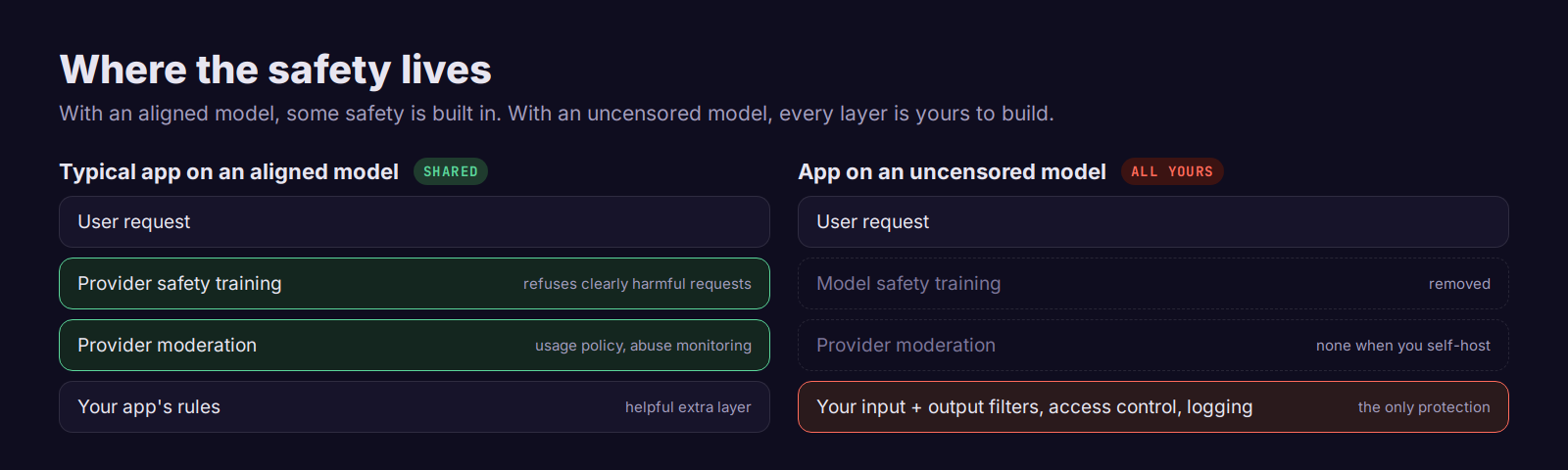
Add your own guardrails. Check inputs and outputs with a safety classifier, such as Llama Guard (Meta), ShieldGemma (Google), NVIDIA NeMo Guardrails or a moderation API. A fast decision model like Jev can also score each request or tool call cheaply.
Control access. Limit it to named people with a real reason to use it, and require login.
Log everything. Keep prompts and outputs so you can review misuse and mistakes.
Keep a human in the loop for anything that reaches a real person, especially medical, legal or financial content.
Download safely. Use well-known publishers and the safetensors format, and check the model's licence.
Write down what is never allowed, whatever the model can do: illegal content, real people's private data, weapons, malware deployment.
Treat it like any other risky dependency: someone must own it, and its limits must be written down. I explain why in AI Technical Debt Explained.
Better alternatives for most people
Give context. "I'm a nurse preparing patient safety material" often turns a refusal into a careful, useful answer.
Use a model known for fewer false refusals rather than one with no safety at all.
Use enterprise or research access programmes, which some providers offer for security and safety work.
The bottom line
Uncensored models are not evil, and aligned models are not perfect. But removing a model's safety does not remove the risk. It just moves all of the responsibility onto you. Use them for specific, supervised, professional work, add your own guardrails, and keep them away from the public. A model that never says no needs an owner who sometimes does.
FAQ
What is an uncensored AI model?
A language model whose safety training was removed or never added, so it answers nearly any request without refusing or adding warnings.
Are uncensored AI models legal?
Downloading and running one is generally legal, but the law still applies to what you create and share with it. Some content is illegal everywhere, and model licences may restrict use. This is not legal advice; check the rules where you live.
Are uncensored models dangerous?
They can be. They make scams, harassment and dangerous technical help easier, give risky advice without caveats, and are easier to hijack through prompt injection. Used in a controlled, supervised setting, the risk is manageable.
Are uncensored models smarter?
No. Removing refusals does not add knowledge, and it often reduces reasoning and instruction-following quality.
What is an abliterated model?
A model where researchers removed the internal direction that controls refusals, based on 2024 research showing refusal is often controlled by a single direction. It stops refusing but may lose some quality.
Can I use an uncensored model in my app?
Not as a public, customer-facing model. If you need one for internal work, add input and output filters, access control, logging and human review.
Reference: Arditi et al., Refusal in Language Models Is Mediated by a Single Direction (2024). Comparison examples in this post are illustrative of typical behaviour, not output from a specific model.